If your procurement brief is to consolidate SKUs before spring without touching molds, here’s the short version: choose a platform that can document fit, ensure UL 1081 system compliance, and sample fast. Mixed generics may win on spot price, but the paperwork and tolerance risk often boomerang into line stoppages and truck‑rolls.
Disclosure: Honest Motor is our product. All Honest‑specific claims in this article are drawn from the provided SOP. Regulatory and reference links are cited where public.
Why big‑brand motors are the default choice in OEM programs
In many OEM projects, branded motors are chosen by default because they are perceived as the safest option—an easy way to de‑risk audits, warranty, and channel expectations. The value is real: standardized documentation packs, predictable quality baselines, and broad field familiarity lower onboarding friction for procurement and engineering teams. When your build plan spans thousands of units with tight ship windows, that perceived safety is a rational hedge.
Why OEMs are actively considering alternatives now
Procurement directors are under pressure to rationalize SKUs, cut exception handling, and protect spring ramp dates. Mixed generic single‑speed ODP motors sourced from multiple suppliers can look attractive on unit price, but they often carry hidden costs: inconsistent 56J/56Y flange tolerances, unclear shaft thread specs, scattered UL paperwork, and uneven lead times. When you’re chasing an eight‑week switch window, every missing CAD file or unverifiable certification can cost days—and days in March feel like weeks.
What you actually buy when you pay the big‑brand premium
You’re paying for a service infrastructure and a consistency promise: stable performance ranges, mature failure analytics, and documentation that tends to pass first‑time audit. That network can be worth the premium on programs with extreme compliance exposure or global field‑service obligations. The point isn’t to diminish big brands; it’s to separate their proven strengths from situations where an ODM platform with the right safeguards can deliver equivalent outcomes at lower total cost.
Where a 56J 56Y universal platform changes the calculus for OEM fit
The job to be done is simple to say and hard to achieve: a pool pump motor 56J 56Y universal replacement that drops into both round C-face and square-flange wet ends with zero retooling, meets UL 1081 system requirements, and holds up outdoors. From the SOP:
- Application fit and dimensional overlays: Honest designs for NEMA 56J and 56Y with a threaded shaft for direct impeller engagement. The platform is intended to achieve zero‑mod retrofits by validating flange, pilot, bolt circle, and stack length via CAD overlays. Reader value: zero mold changes means no tool rework and fewer line disruptions.
- Materials for outdoor duty: A rolled steel shell with epoxy paint is positioned for impact resistance and improved salt‑spray endurance in chlorinated or salt pools. Reader value: delaying red rust reduces RMA rates and protects brand reputation.
- Outdoor ODP countermeasures: Where TEFC isn’t specified, the weather‑resistant ODP concept adds a Triple‑Seal approach—an internal slinger to centrifuge water away, 2RS sealed bearings, and weep holes to purge condensation. Reader value: mitigating rain ingress avoids the bearing whine‑to‑seizure cascade that triggers emergency replacements.
- Compliance posture and thermal headroom: UL1081 is treated as a go‑to safety bar for swim pool pumps, and Class F insulation (155 °C) supports hot pump‑room summers. Reader value: fewer certification surprises and lower odds of insulation breakdown in high ambient.
- Program speed: Samples can be provided in 7–10 days per SOP, enabling an ≤8‑week platform switch when paired with fast bench‑fit and pilot runs. Reader value: you make the spring window without over‑buying safety stock.
For engineers new to identifying frame interfaces: the industry distinguishes 56J (round C‑face) and 56Y (square flange) by flange geometry and suffix codes; a practical overview is explained in the InyoPools frame guide, which shows how to confirm the interface before approving a swap. See the explainer on identifying NEMA 56J vs 56Y frames in the industry’s instructional guide: how frame ratings translate to round C‑face and square‑flange fit.
Side‑by‑side comparison for SKU consolidation decisions
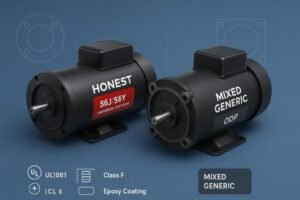
Two practical options emerge for single‑speed replacement programs aimed at zero‑mod fit and paperwork confidence. The table focuses on procurement‑critical dimensions.
| Dimension | Honest Single‑Speed Platform (SOP‑based) | Mixed Generic Single‑Speed ODP (multi‑supplier) |
|---|---|---|
| Mechanical interface fit | Designed for NEMA 56J and 56Y; threaded shaft; targets zero‑mod via dimensional overlays. Value: avoids mold changes and line delays. | Round vs square flange typically available, but tolerance stacks and shaft thread details vary; more trial fits and rework risk. |
| Dimensional assets | Provides 2D/3D CAD intent with tolerance call‑outs for sign‑off. Value: faster engineering approval. | Often limited drawings; STEP files uncommon; fit must be proven per supplier. |
| Compliance evidence | UL 1004 certified; design optimized for UL 1081 system-level evaluation (e.g., waterproof and corrosion testing). | “Meets standards” claims may lack File Numbers; higher risk of audit slippage. |
| Weather exposure | Triple‑Seal ODP concept (slinger, 2RS bearings, weep holes) to mitigate rain ingress without TEFC cost. | Many bare ODP designs disclose minimal moisture mitigation; outdoor exposure raises bearing failure risk. |
| Shell and coating | Rolled steel shell with epoxy paint for impact and corrosion resistance. | Coating systems vary; salt‑spray endurance often undocumented. |
| Thermal & insulation | Class F insulation (155 °C) for summer pump‑room conditions. | Mix of Class B/F by supplier; documentation inconsistent. |
| Lead time | Samples in 7–10 days (SOP); supports ≤8‑week platform switch. | Varies widely; retail stock doesn’t equal engineering sample readiness. |
| Documentation pack | BOM‑level transparency approach (bearing 2RS, enamel grade), UL pack, install guides. | Sparse and inconsistent; slows approvals. |
| Price band | Program pricing varies by HP/coatings; evaluate on TCO, not just unit price. | Often lowest unit price; quality and paperwork variability can increase total cost. |
| Net TCO impact | Residential single‑speed: SOP models savings of $300–$400 over three years by avoiding two emergency truck‑rolls. | Lower first cost but higher probability of fit rework and post‑rain failures increases lifecycle cost. |
Notes: UL1081 verification can be performed in the UL database; see method below. For enclosure selection, ODP is open by design; TEFC may still be appropriate for certain outdoor exposures—see the ABB engineering note linked below.
Risk comparison focused on installation fit, compliance, and TCO
| Risk area | If you consolidate to a 56J 56Y universal platform | If you maintain mixed generic ODP suppliers |
|---|---|---|
| Fit and retool risk | CAD‑verified overlays are designed to minimize pilot and bolt‑circle surprises; zero‑mod is the default target. | Each supplier’s tolerance stack must be re‑verified; higher chance of on‑line interference or reseal work. |
| UL1081 audit readiness | A verifiable UL 1004 File Number that supports UL 1081 system-level audits and reduces certification delays. | “Meets standards” without a File Number can trigger retests and schedule slips. |
| Outdoor failure modes | Internal slinger, 2RS bearings, and weep holes are intended to mitigate rain‑induced bearing seizure. | Bare ODP is more susceptible to rain ingress; bearing whine → seizure → truck‑rolls. |
| Lead‑time predictability | 7–10 day samples per SOP help you hit an ≤8‑week switch. | Lead times vary with each vendor; spring volatility can derail pilots. |
| Unit price vs lifecycle | May not be the lowest unit price; modeled to reduce emergency service costs over three years. | Lowest unit price possible; lifecycle costs rise with rework, RMAs, and field calls. |
When you should not replace a big brand
- Extreme compliance exposure where in‑place certifications and global warranty frameworks outweigh any savings.
- Programs that mandate a worldwide service footprint with field swap‑outs in multiple regions on fixed SLAs.
- Projects locked to an OEM’s long‑standing channel commitments that explicitly require named‑brand components.
Decision framework to execute an eight‑week consolidation
Use these questions to pressure‑test your path to a pool pump motor 56J 56Y universal replacement without retooling:
- Can your engineering team sign off a dimensional overlay within five business days once STEP and 2D face drawings are received? Acceptance clue: pilot concentricity tolerance at or below your shop threshold.
- Is a verifiable UL 1004 File Number required by your cert body, and can the supplier map the design to UL 1081 system requirements?
- Do your installs sit outdoors or near saltwater, making rain ingress and corrosion a common warranty driver? If yes, insist on weather‑resistant ODP measures or specify TEFC.
- Will 7–10 day samples allow you to bench‑fit, pilot, and release MP inside eight weeks? If not, identify bottlenecks now.
- Are you consolidating from multiple suppliers to reduce MOQs and labeling complexity across 56J and 56Y? Confirm the threaded shaft spec and through‑bolt geometry early to prevent line surprises.
Pricing and regulatory scope update
- Scope and date: Pricing, MOQs, and regulatory interpretations are as of 2026‑02‑07 and subject to change by geography and program terms. For context on generic retail price bands, distributor listings show a broad range; for example, a 56J single‑speed replacement at 1.5 HP has been advertised in the low hundreds of dollars in retail channels. OEM contract pricing is negotiated and depends on coatings, bearings, volume, and SLAs.
- DOE timelines: Dedicated‑purpose pool pump motor efficiency rules are phased by total horsepower bands; the DOE’s final rule outlines effective dates across THP ranges, which can influence your roadmap toward multi‑speed or variable‑speed designs. See the U.S. Department of Energy’s official final rule document for dedicated‑purpose pool pump motors for timing and scope: DOE’s published final rule PDF on DPPPM effective dates and thresholds.
- Certification verification: Auditors and OEMs can verify the UL 1004 listing by querying UL’s database. Use the File Number to confirm the motor’s safety foundation and insulation system lineage, which serves as the prerequisite for final UL 1081 system-level evaluation.
For enclosure selection on outdoor duty, engineering notes from the industry explain that ODP designs protect against limited drips while TEFC tends to be preferred for dirty or harsh outdoor environments. That trade‑off is discussed in ABB’s technical paper: engineering guidance on ODP versus TEFC for outdoor applications. Technical Clarification on UL 1004 vs. UL 1081:
- UL 1004: The safety standard for the motor unit itself, covering electrical and insulation assessment.
- UL 1081: The safety standard for the complete pump system. While motors do not receive individual UL 1081 certificates, they must comply with UL 1081’s environmental and durability requirements when integrated and exported as part of the finished pump.
FAQ for procurement and engineering
How do I confirm a 56J motor will drop into my Hayward‑style round C‑face wet end without retooling?
- Request STEP and 2D face drawings with flange pilot, bolt circle, and stack length tolerances, then run a CAD overlay.
What documentation proves a replacement motor is UL1081 compliant?
- The motor holds UL 1004 (Component Safety) certification. While it doesn’t receive a standalone UL 1081 certificate, our design includes the specific countermeasures (seals, slingers, and corrosion resistance) required to pass the UL 1081 system test once integrated into the pump.
Can an ODP motor survive outdoor rain exposure without moving to TEFC?
- ODP is open by definition; however, weather‑resistant measures—an internal slinger, 2RS sealed bearings, and weep holes—are designed to mitigate rain ingress in typical installs. Where contamination or severe exposure is expected, TEFC may still be the better choice.
What is the minimum CAD deliverable I should insist on to avoid fit failures?
- STEP files and 2D face drawings that explicitly call out flange pilot diameter, bolt‑circle diameter, shaft thread spec, and stack length. A five‑business‑day overlay sign‑off window is a practical target for an eight‑week consolidation.
Do I need to worry about DOE timelines on single‑speed motors today?
- Yes—efficiency rules phase in by THP and can push programs toward multi‑speed or VS. The authoritative timing is in the DOE’s final rule PDF: official DOE document on dedicated‑purpose pool pump motor standards.
Conclusion
For OEM projects where application fit, documentation traceability, and schedule certainty matter more than winning the lowest possible unit price, a 56J 56Y universal replacement platform that can demonstrate fit by CAD overlay, confirm UL 1081 design compliance, and sample in 7–10 days is the pragmatic path. Where the only KPI is first cost and you can absorb higher fit and warranty risk, a mixed set of generic ODP motors may suffice. Share your wet‑end interfaces, target HP, and schedule, and we can assess the fit and consolidation plan within a single planning call. You can also start with a quick overview of Honest Motor here: Honest Motor homepage.