Modern high-pressure washers don’t fail gracefully. When the motor is marginal on start torque, sensitive to line voltage drop, or poorly protected against moisture and dust, the failure mode shows up where it hurts: intermittent “humming/no-start,” nuisance GFCI trips, thermal shutdowns, and returns that eat into seasonal demand.
This guide is for selection and development teams building high-pressure washers—from common household models to light commercial platforms—who need a practical way to specify and validate non-standard (custom) motors for real-world starting, environmental, and reliability demands.
Why standard pressure washer motors fail in real duty cycles
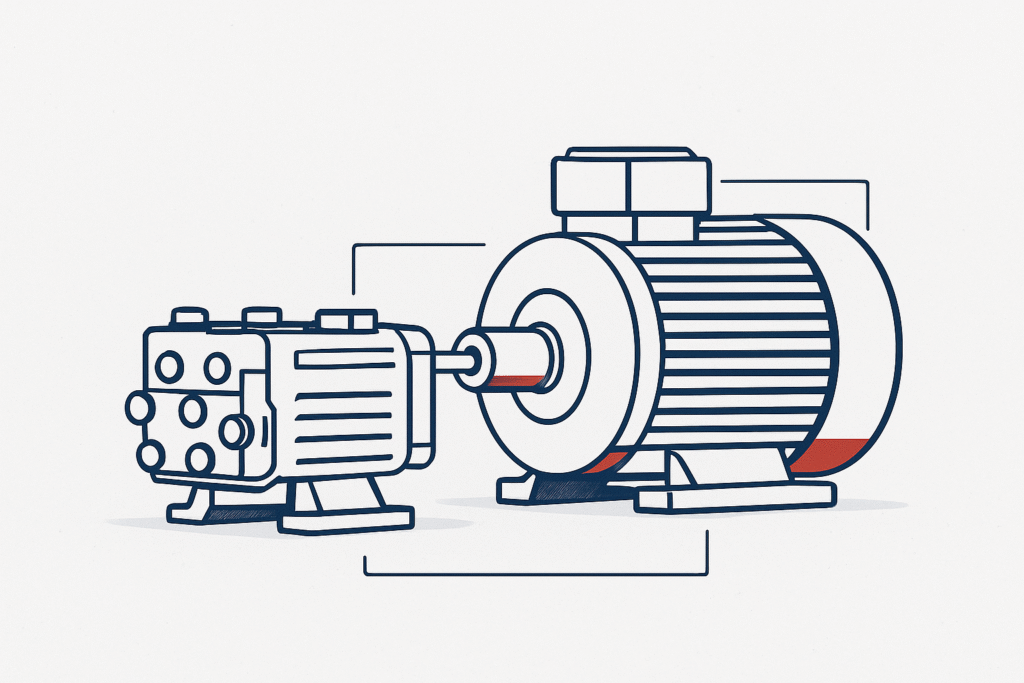
High-pressure washers combine a motor with a positive-displacement pump and an operator-controlled spray gun. That stack-up creates a workload that is different from a fan, a conveyor, or a steady-state pump.
Duty cycle reality: start–stop and impact-like load steps
When the spray gun opens and closes, the system experiences rapid load changes. For the motor, that translates into repeated transitions and short-duration stress events—exactly the kind of environment where marginal starting torque and weak overload margin surface first.
From an engineering selection standpoint, you’re not just buying watts. You’re buying start behavior, stall recovery, and survivability under repeated impact-like load steps.
Environment exposure: moisture, dust, and chemicals
Even “consumer” washers live outdoors, in garages, on job sites, and around wet surfaces. The motor sees water vapor, splashing, dust, and cleaning agents. This is why enclosure choice and cooling architecture are not cosmetics—they are reliability decisions.
A common industrial reference point here is the concept of a TEFC enclosure. TEFC (Totally Enclosed Fan Cooled) describes a motor enclosure that does not allow outside air to freely circulate through the motor interior, and instead uses an external fan to cool the frame (see the definition in TEFC motor).
Why custom motors make sense for pressure washer duty cycles
If you design for the real duty cycle—startup under voltage drop, frequent trigger events, and wet/dusty operation—“closest catalog motor” selection often becomes an iteration loop of field issues.
In other words, this is where non-standard motor selection for pressure washer platforms becomes an engineering process—not a catalog exercise.
A custom motor program lets you lock the selection around:
- the actual start margin needed for your pump and line conditions,
- the mechanical interface needed for alignment and durability, and
- the environmental tolerance your warranty profile requires.
Custom pressure washer motor specification checklist
Below is the practical interpretation of “key parameters” for high-pressure washer motors. The selection logic is framed around failure modes because that’s how warranty and returns behave.
Power and load: wattage range + pump start torque
In many OEM programs, a common target band for single-phase induction motors in this category is 2100–3000 PSI with 1100–2200 W motor power coverage (as a reference example for household to light commercial platforms). Use these numbers as a classification boundary—then validate that the motor can handle:
- your pump’s starting condition,
- your expected pressure regulator behavior, and
- your duty cycle (how often the gun is actuated and how long the motor runs).
To make this actionable, quantify your worst-case electrical condition at the motor terminals (not at the wall):
- assume a minimum line voltage under inrush (including circuit drop),
- define the extension-cord policy you expect customers to use (or the worst case you want to survive),
- then check that starting torque and start current behavior still produce a clean start.
What this prevents commercially: power-only matching tends to overfit the brochure and underfit the warranty.
Starting torque under voltage drop (prevent “humming/no-start”)
In field conditions, many “no start” events are not an average-load problem—they are a starting torque margin problem.
For high-pressure washer applications, one proven lever is High-Start Torque with Dual Capacitor (“dual capacitor high start torque”). Practically, this is what many OEMs are trying to secure when they search for a dual capacitor high start torque motor that can handle voltage dip plus cable losses.
The engineering point is straightforward: a dual-capacitor start approach is aimed at improving start capability when the motor would otherwise stall or hum under difficult electrical conditions.
This matters most in the exact scenarios that create bad reviews:
- low line voltage,
- long extension cords,
- cold starts, and
- repeated start–stop cycling.
If the motor hums but doesn’t start, it can be drawing stalled current. That is a thermal risk and a fast path to returns. Consumer troubleshooting articles commonly describe “humming/buzzing but not starting” as a symptom of insufficient starting capability in the start circuit context (example: Karcher pressure washer buzzing—what it means).
Duty cycle and frequent start–stop: treat trigger events as a design input, not an afterthought
High-pressure washers are often evaluated as if they are continuous-run machines. In reality, the spray gun creates repeated transitions and intermittent shock loading.
Selection implications: prioritize a robust start system, thermal margin that accounts for repeated inrush, and a mechanical interface that holds alignment and coupling integrity under cycling.
Thermal margin and insulation system: specify what “survives hot” means
A common baseline for motors in this category is Class F (155°C) insulation. From a reliability perspective, insulation class isn’t a marketing checkbox—it’s part of the safety margin between a hot duty cycle and a winding failure.
Insulation class alone doesn’t “guarantee reliability.” Treat it as a minimum requirement, then validate the full thermal system under representative use.
Validation actions to include:
- Temperature rise check: define a realistic ambient (and blocked-airflow) condition, then verify winding temperature rise under a trigger-heavy duty cycle.
- Thermal cycling check: run repeated start–stop cycles and short overload events and watch for drift (slower starts, capacitor overheating, nuisance trips).
Also review the thermal protector / overload strategy early (trip curve, reset behavior, mounting location). A good protector prevents damage; a poorly matched one becomes a customer-visible nuisance trip.
TEFC vs open designs for wet and dusty use
TEFC (Totally Enclosed Fan Cooled) is a common structural baseline for outdoor or harsh operation. The selection logic is simple: if the motor lives in moisture and dust, you want an enclosure strategy that reduces contaminant ingress and supports durable cooling.
The real surprises usually come from the combination of:
- high humidity + temperature swings (condensation risk),
- chemical exposure from detergents/cleaners, and
- fine dust that turns abrasive when mixed with moisture.
To reduce environment-driven failures, specify and validate the basics:
- corrosion-resistant coatings/hardware,
- sealing and cable entry details at high-risk points,
- representative humidity/condensation, splash, and dust checks (then re-check insulation resistance and bearing noise).
Commercially, this shows up as fewer environment-related returns and more consistent performance across regions.
Mechanical interface: NEMA 56C, hollow shaft, alignment
For pressure washers, motor-to-pump integration is not forgiving. Common interface strategies include a NEMA 56C face or a hollow shaft design to ensure mechanical matching to plunger pumps.
What “compatible” should mean in practice (not just on paper):
- Alignment and tolerance control: define pilot diameter/face runout, shaft runout, and the allowable coupling misalignment so the pump doesn’t see side-loading that accelerates seal and bearing wear.
- Interface durability under start–stop stress: frequent gun-trigger events create repeated torque reversals/steps. Review fastener retention, keyway/spline wear allowance, and whether the face mount can hold alignment after vibration and thermal cycling.
- Coupling choice for impact-like load steps: for repeated load switching, consider flexible or elastomeric couplings (where appropriate) to absorb shock and reduce transmitted vibration—while still meeting your torque and concentricity requirements.
Selection takeaways for PM/quality/procurement reviews: define the mounting interface and tolerance stack explicitly, treat coaxiality/alignment as reliability parameters, and ask for evidence the coupling and interface stay stable after start–stop cycling and vibration validation.
Work backwards from your duty cycle to select a reliable custom motor
A useful selection process starts with the failure you are trying to prevent, then specifies the motor features and validation that block that failure mode.
Load characterization: define the torque problem you need to solve
For high-pressure washers, the key engineering question is: What torque margin is required to start and re-start the pump under your worst electrical condition?
In practical OEM work, “worst electrical condition” is rarely nominal voltage at the wall outlet. It is the combination of:
- a real-world circuit,
- voltage drop under inrush,
- and the customer’s extension-cord behavior.
This is why start strategy choices—such as low-voltage start intent and dual capacitor high-start torque—should be reviewed together as a system.
Environment as a constraint: moisture and dust force enclosure and sealing decisions
If your washer is intended for outdoor work or high-humidity storage, treat TEFC as a baseline structural decision, then define the rest of the protection strategy around the true exposure pattern.
The important selection discipline is not “pick TEFC.” It is “define the exposure + define the life expectation + validate.”
Thermal management: don’t let temperature rise become a returns generator
Temperature endurance is a core part of reliable operation. The engineering principle is consistent across motor categories: if repeated start–stop events and load steps drive temperature rise, you must validate thermal stability under representative use.
This is also where simulation can be used responsibly.
Common pressure washer motor selection mistakes (and how to avoid them)
High-pressure washer motor problems are often selection problems that show up as quality incidents.
Mistake 1: selecting by rated power while ignoring start behavior
Rated power classifies the platform, but it doesn’t guarantee a clean start on a marginal circuit. Prevent this by defining your worst-case voltage at the motor terminals and reviewing start torque margin and the start circuit strategy.
Mistake 2: treating the environment as a minor housing detail
Moisture, dust, and chemicals are failure drivers, not cosmetic concerns. Prevent this by matching the enclosure approach (often TEFC) to the exposure pattern and validating it.
Mistake 3: underestimating thermal margin
Thermal issues often show up as “random” shutdowns. Prevent this by validating temperature rise and start–stop thermal cycling under representative duty, not just by checking insulation class.
Pressure washer motor selection framework: match features to worst-case conditions
You don’t need dozens of motor variants. You need a defensible framework that maps your worst conditions to design choices.
Frequent start-stop use
Prioritize start margin and mechanical robustness (start circuit + interface stability).
Low-voltage starts and long cables
Design around voltage drop: start reliably at low terminal voltage, not just at nominal wall voltage.
Wet and dusty environments
Treat enclosure and sealing as reliability controls (often TEFC) and validate for moisture, dust, and chemical exposure.
When to choose a standard motor vs a non-standard (custom) motor
Use a standard motor only when all of the following are true:
- your pump interface is truly standard and proven in the same duty cycle,
- your start conditions are controlled (no meaningful voltage drop risk),
- your environment is mild enough that enclosure choice is not driving failures.
If any of those conditions are uncertain, a custom motor route is often the faster way to stop iteration—because you can lock the design around your actual constraints.
How to run a non-standard motor program: requirements, design, and verification
A custom motor program succeeds or fails on inputs and validation discipline.
Step 1: quantify the load and operating condition—before anyone quotes a motor
At minimum, define:
- target performance band (pressure class and motor power range)
- startup scenario (minimum terminal voltage, extension-cord assumptions)
- duty cycle (starts per hour, run time per session, trigger pattern)
- environment exposure (humidity/condensation, dust, chemical agents)
- mechanical interface requirements (mount, shaft/coupling, alignment tolerances)
Step 2: where simulation fits
Simulation (including FEA) is most useful when it reduces risk early—before tooling and long validation loops. Focus on thermal behavior under your defined duty cycle, hotspot sensitivity, and repeated start–stop response. Keep the model tied to the same duty definitions you used in Step 1.
Step 3: what to require in the engineering packet
From an OEM sourcing perspective, “we need a motor for a 3000 PSI washer” is not an RFQ. Require an engineering packet that covers:
- electrical constraints (nominal voltage, allowable dip, circuit assumptions)
- mechanical interface drawings and tolerance stack
- environment definition
- validation checklist (start–stop cycling, thermal stability, dimensional verification)
Because high-pressure washers are commonly used on GFCI-protected circuits, plan for GFCI-related validation. For reference, UL notes Class A devices are associated with a 6 mA trip-current requirement (see UL’s new GFCI classes).
Custom pressure washer motor RFQ checklist
Engineering input checklist (send this with your RFQ)
- Equipment class: target PSI band and target motor power band
- Worst-case start condition: minimum expected line voltage at the motor terminals (include allowed voltage fluctuation range)
- Customer behavior assumption: extension cord length/gauge policy (if any)
- Duty cycle: starts per hour, on-time per session, trigger actuation pattern
- Environment: humidity/dust/chemical exposure level, chemical splash exposure, and storage conditions
- Interface: NEMA 56C face vs hollow shaft preference; shaft/shaft extension dimensions, allowable runout, and coupling constraints
- Alignment/tolerance expectations: pilot/face fit targets and allowable misalignment at the coupling
- Validation evidence requested: humidity/condensation + dust + chemical exposure checks (and what “pass” means)
- Thermal and protection requirements: thermal cycling expectation, overload/thermal protector behavior, and target limit for nuisance trips
- Reliability target: return-rate sensitivity (what failures are unacceptable)
Next step
If you want an engineering-level motor matching review for your 2100–3000 PSI platform, start with the checklist above and then share your interface drawing + worst-case start condition. You can also browse Honest’s High-pressure cleaner motor solutions and our single-phase AC induction motor platform to align on the starting point before a full custom design review.